FREQUENTLY ASKED QUESTIONS
01: How do mask filters work?
Mask filters clean the air you breathe in. Particle filters trap dust, mist and fume in a fibre layer, while gas and vapour filters use activated carbon to adsorb chemicals. Combination filters do both. Mask filters only work with the mask they’re approved for, and have a limited life, so choose the type and class for your hazard.
02: What is a mask dust filter, and what do P1, P2 and P3 mean?
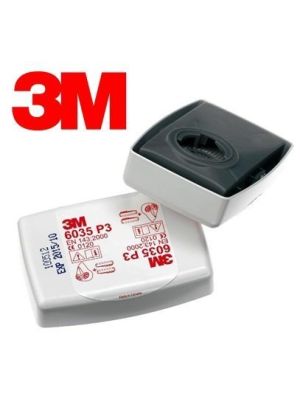
A mask dust filter is a particle filter that traps dust, mist and fume. Under EN 143, P1 filters remove at least 80% of particles, P2 at least 94% and P3 at least 99.95%. P3 is the highest class and suits fine hazardous dusts. Fit the class your risk assessment requires, and replace the filter when breathing gets harder.
03: What is the difference between 3M 6051, 6055, 6057 and 6059 mask filters?
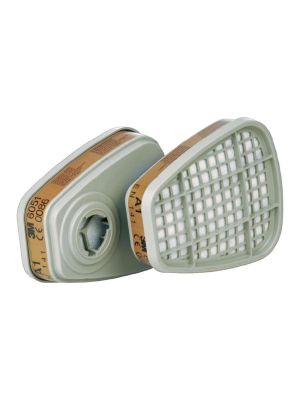
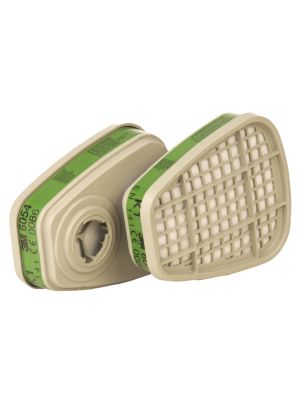
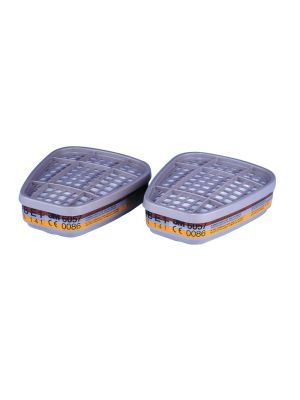
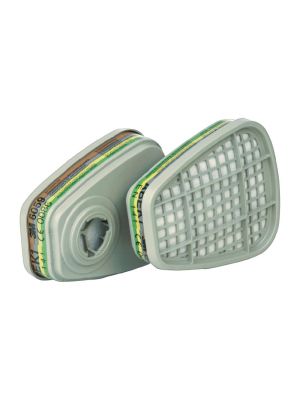
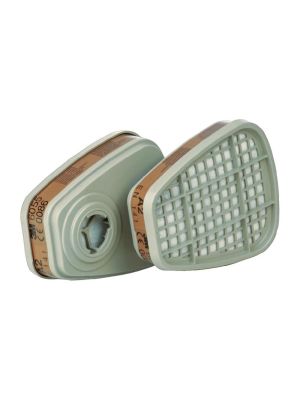
3M mask filters for the 6000 series differ by gas type. The 6051 (A1) and 6055 (A2) filter organic vapours, the 6054 (K1) filters ammonia, the 6057 (ABE1) adds inorganic and acid gases, and the 6059 (ABEK1) covers all four. A2 has higher capacity than A1. Add a particle filter if dust is also present.
04: What are JSP Press To Check mask filters?
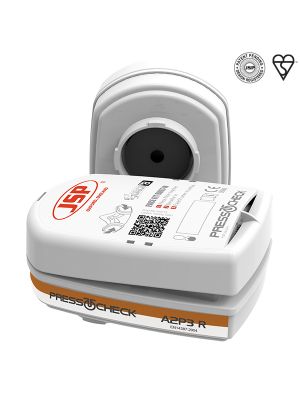
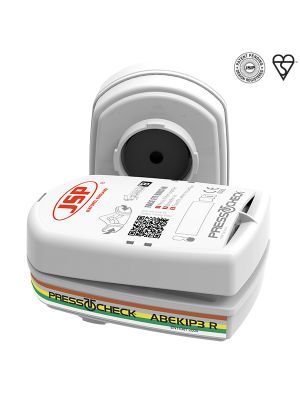
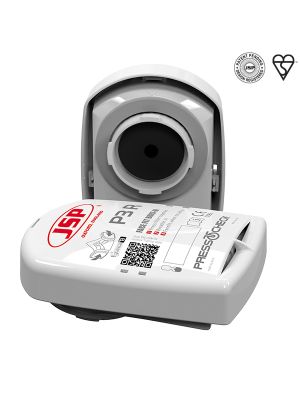
JSP Press To Check filters are replaceable filters for JSP Force 8 and Force 10 masks, designed to make the seal check quick before you enter a hazard area. Our JSP mask filters include P3 dust, A2 P3 and ABEK1 P3 versions, sold in sets of two. Follow JSP’s instructions for the check, and replace filters on schedule.
05: Is an air filter mask the same as a respirator?
Only if it’s certified. A true air filter mask is a respirator tested to an EN standard, such as FFP masks (EN 149) or half masks with filters (EN 140). Fashion or pollution masks without EN markings aren’t tested for workplace hazards. Check the standard, CE or UKCA marking and filter class before relying on any air filter mask.
06: Do I need a combination filter or separate gas and particle filters?
Use a combination filter, such as A1 P3 or ABEK1 P3, when you face vapours and dust or spray together, as it protects against both in one cartridge. Use a gas filter alone when there are no particles. Some masks accept a particle pre-filter over a gas filter, so check the compatible combination for your mask and never stack unapproved parts.
07: Do I need to buy mask filters in pairs?
Most half masks take two filters, so buy them in pairs and change both together. Many of our filters are sold in packs of two, with larger packs of 10 for some models. Some full face masks take a single filter, so check how many your mask needs.
08: Do the same mask filters fit half and full face masks?
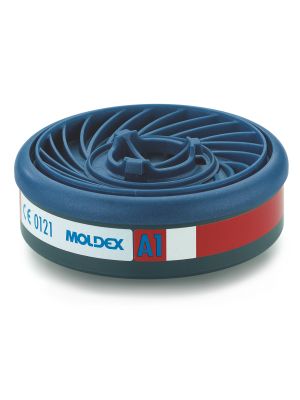
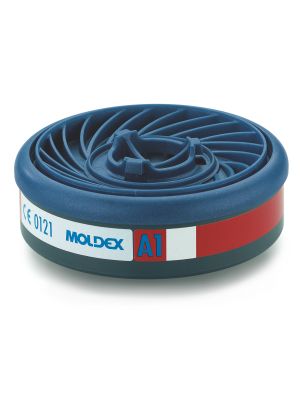
Often within the same brand system, but not usually across brands. For example, Moldex 7000 and 9000 filters, 3M 6000 series filters and JSP Force 8 and Force 10 filters are listed for both half and full face masks. Always check the compatibility shown on the listing and the mask’s instructions before ordering.
09: How long do unopened mask filters last, and how should I store them?
Unopened filters usually have a shelf life of several years, shown by the expiry date on the pack. Keep them sealed in their original packaging in a cool, dry place away from sunlight and chemicals. Once opened, gas filters start absorbing contaminants from the air, so reseal them in an airtight bag between uses and replace them within the manufacturer’s limit.
10: What are AX filters used for?
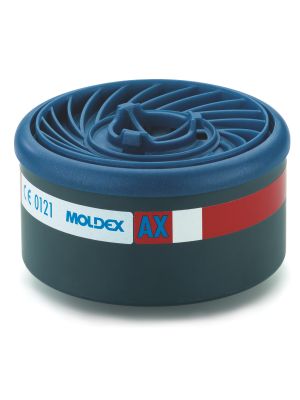
AX filters protect against low-boiling-point organic compounds, with a boiling point of 65°C or below, such as some solvents, which A filters don’t cover. They are typically single-use, so replace them after use or within the manufacturer’s stated time. Our Moldex AX filters (code 9600) fit the 7000 and 9000 series masks.