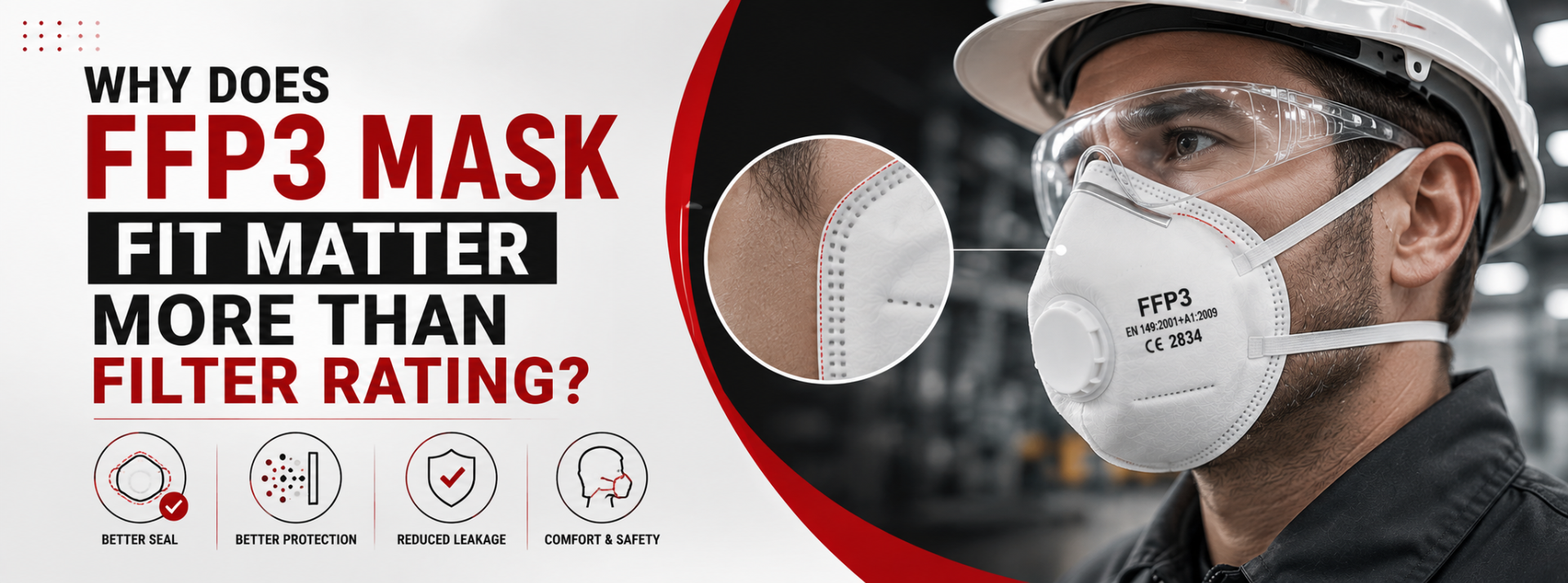
The filter inside an FFP3 mask captures 99% of airborne particles, which is tested, certified, and printed on the packaging. What isn't printed is how much inhaled air bypasses that filter entirely through a gap at the seal.
The HSE sets FFP3 total inward leakage at a maximum of 2%. If it exceeds, the mask's protection is compromised regardless of its filter grade. This is why face fit testing is the only way to know the mask is working.
Filtration efficiency tells you how a mask performs in a lab. Fit determines how it performs on your face. Keep reading to find out why the seal matters more and what to do about it.
Does an FFP3 Mask Actually Protect You If It Doesn't Fit Properly?
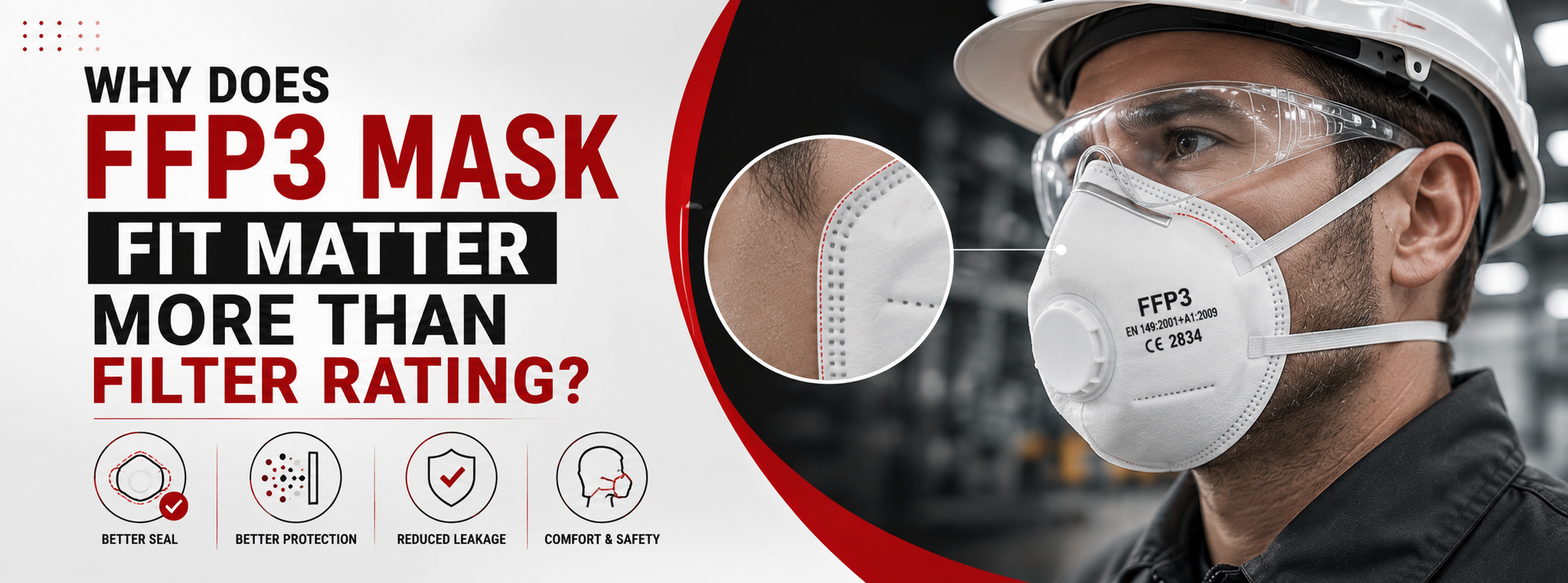
No, and this is the most important thing to understand about respiratory protective equipment. An FFP3 dust mask is a sealed system. Contaminated air should enter only through the filter. If the face seal fails, unfiltered air bypasses the filter entirely with every breath.
The filter grade, including FFP1, FFP2, or FFP3, tells you how efficiently the filter handles particles that pass through it. It says nothing about the seal. A worker wearing a protective mask with a compromised seal receives only a fraction of the stated protection, and they won't know it.
What Is Total Inward Leakage and Why Does It Matter More Than Filtration Efficiency?
Total Inward Leakage, or TIL, can be referred to as the total amount of airborne contaminant that enters a respirator’s breathing zone through filter media or gaps around the face seal. It matters more than material filtration efficiency because even a 99.9% efficient filter offers zero protection if the contaminated air bypasses the mask through the gaps.
There are three classes of filtering facepiece respirators under EN 149, and they differ based on TIL and filtration efficiency:
| FFP Class | TIL | Filtration Efficiency |
|---|---|---|
| FFP1 | No greater than 22% | At least 80% |
| FFP2 | No greater than 8% | At least 94% |
| FFP3 | No greater than 2% | At least 99% |
What Actually Happens When an FFP3 Mask Doesn't Seal Properly?
If the seal between the FFP3 face mask and the wearer's skin isn't consistent, contaminated air enters through the path of least resistance. It is usually around the nose bridge, along the chin, or beside the cheeks. When the contaminated air enters the breathing zone unfiltered, the wearer may feel and smell nothing unusual. But exposure to silica dust, metal fumes, or airborne pathogens may affect their long-term health if it continues at concentrations the mask rating was designed to prevent.
Here’s where most fit checks fail:
- Along the nose bridge: Particularly when clips are not stiff enough or are too stiff for the facial structure
- Around the chin edge: Particularly with cup-shaped masks on longer or narrower faces
- At the cheek junction: If there is a difference in the facial contour from that of the mask’s design
- Along the seal line on bearded or stubbled skin: Even short stubble breaks the seal.
How Common Is It for FFP3 Masks to Fail a Fit Test?
It is quite common for FFP3 masks to fail a fit test. As per research conducted by the Dental Public Health Team, Public Health England North East and Yorkshire Region, UK, it was reported that 1 out of 5 failed the fit testing of FFP3 respirators. This means that the failure rates typically range from 15% - 30% on an initial test for a given mask model.
Here are some common reasons for failures:
- Facial dimensions and unique face shapes that do not match the specific mould of the respirator.
- Facial hair or stubble which breaks the airtight seal.
- Wearing the mask improperly or failing to adjust the nose clip properly.
Why Do Some Faces Fail to Seal With Certain FFP3 Models?
Face shape varies for every individual. Most FFP3 dust masks are designed around a population average. Narrower faces, high cheekbones, deep-set chin profiles, and prominent nasal bridges create sealing challenges that a standard mask shape cannot accommodate.
Mask Options for Difficult Face Profiles
- Try a different size: The Sundstrom mask SR100 comes in three sizes to address the differences in face profiles.
- Switch to a different shape: A cup-shaped mask seals differently from a foldable one. Try both before concluding a worker can't be fitted.
- Consider a reusable half mask: A silicone half face mask body conforms to individual face contours more precisely than foam-edged disposables.
What's the Difference Between a Fit Check and a Fit Test?
A daily fit check confirms the seal is in place. A formal fit test proves the mask model is appropriate for that individual. Let’s take a look at the difference:
Fit Check: Daily, Before Each Use
The user blocks the exhalation valve or covers the filter. Next, they take quick breaths to detect leaks visually. The whole procedure will not take more than a few seconds. Every employee should perform it every time they put their mask on.
Fit Test: Formal, Per Mask Model
A fit test is an official test done by an assessor who checks to confirm that a certain design of mask fits a particular wearer. The process is mandatory by law under COSHH for all tight-fitting RPE.
How Does a Face Fit Test Actually Work?
There are two accepted methods in the UK. Both assess seal quality using a face fit testing kit or specialist equipment. But the assessment method differs.
Qualitative vs Quantitative Fit Testing
| Factor | Qualitative | Quantitative |
|---|---|---|
| Method | Detects taste or smell of challenge agent | Counts particles inside vs outside the mask |
| Result | Pass or fail (subjective) | Fit Factor (objective numerical score) |
| Suitable masks | Half masks and disposable FFP3 | All tight-fitting masks including full face |
| Equipment | Face fit test kit with hood and agent | Particle counter (e.g. PortaCount) |
| Cost | Lower | Higher |
| Common use | Most occupational RPE programmes | Higher-risk industrial or healthcare settings |
If you are in occupational environments, check the disposable FFP3 face masks and half masks. Checking the masks using qualitative testing with face fit test solutions is the standard approach. Quantitative testing is preferred when you need a precise numerical fit factor.
What to Do If Your FFP3 Mask Keeps Failing Fit Tests
Don't keep testing the same model and hoping for a different result. Here’s step-by-step when you can't pass an FFP3 fit test:
- Step 1: Try a different size of the same mask model first
- Step 2: Switch to a different mask shape. Choose cup vs foldable vs moulded.
- Step 3: Try an alternative brand such as a 3M mask with a different seal design
- Step 4: If disposables fail every time, switch to a reusable silicone half mask. It conforms more precisely to individual face profiles
The Bottom Line
An “FFP3 99% filter” has no meaning if there is no proper sealing of the mask. If there is no tested sealing of the mask, it doesn’t matter how many per cent the filter catches. What matters is how much the inward leakage is. The only method by which we can check whether it fits the criteria of the 2% HSE standard is fit testing. Make sure you get the correct model that matches your face and do the test whenever something changes.
Check out our certified FFP3 face masks, half masks, and face fit test kits at Respirator Shop. We have multiple sizes and models to ensure every worker achieves a compliant seal.
Frequently Asked Questions
1. Do I need a face fit test every time I use an FFP3 mask, or just once?
A formal fit test is required once per mask model. A fit check should be done every time the mask is put on before entering a hazardous environment.
2. Can a fit check replace a fit test?
No. A fit check detects obvious seal failures. A formal fit test confirms the mask model provides adequate protection for that specific wearer. COSHH requires formal testing.
3. Does facial hair really affect FFP3 seal quality?
Yes. Any hair along the seal line, including stubble, breaks the face seal and makes a tight-fitting ffp3 face mask non-compliant. Bearded workers should use a loose-fitting powered air-purifying respirator instead.
4. Is a half mask respirator more reliable than a disposable FFP3 for fit?
Yes. A reusable half mask with a silicone body conforms to face contours more precisely. It also maintains a consistent seal across a long shift. It still requires formal fit testing.
5. How do I know if my fit test result is still valid?
A result remains valid unless the wearer changes mask model, has any visible facial changes (dental work, weight change), or the mask is discontinued. HSE guidance recommends retesting whenever there's doubt about seal integrity.