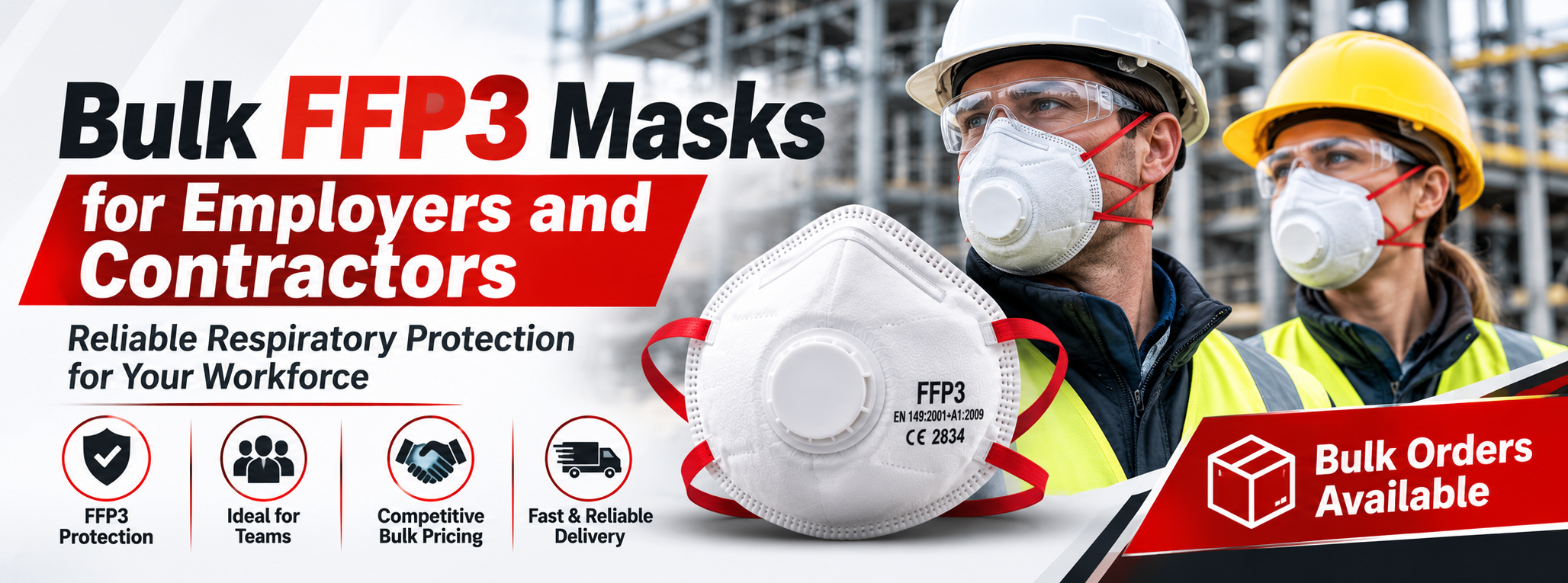
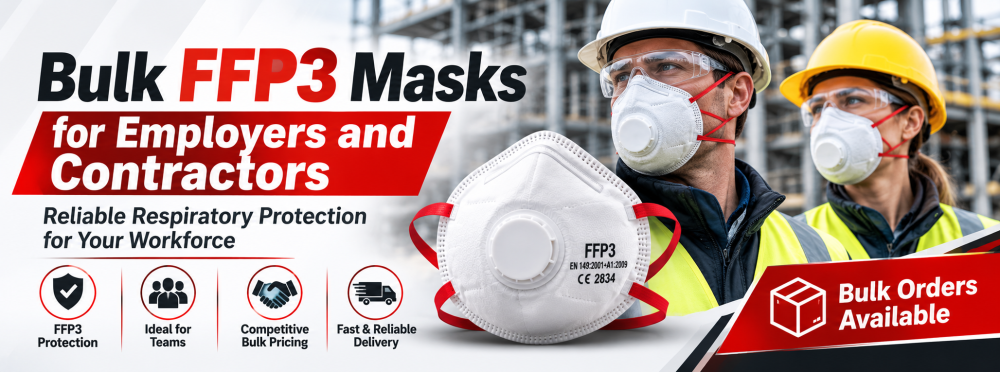
If you are an employer or contractor managing a site team, you might be wondering how to buy FFP3 face masks for a whole team without getting it wrong. Buying FFP3 protection in bulk is easier than it looks: start with proof of compliance, then check fit and quantity.
Bulk buying lowers your cost per mask and keeps stock on the shelf. It shouldn’t cut corners on protection. A clear process also keeps your paperwork tidy for clients and inspectors.
This guide will show you how to go through the checklist for your next order, including recognising fakes, planning quantities, and comparing real costs.
What Should You Check Before Buying FFP3 Masks in Bulk?
An FFP3 mask is a filtering facepiece respirator, far above a basic dust mask. It captures at least 99% of airborne particles, as listed in the proper FFP3 range. HSE gives it an assigned protection factor of 20.
The workplace-related issues are becoming more life-threatening. In fact, HSE estimates 11,000 lung disease deaths a year are linked to past exposure at work.
Before you commit to a big order, consider the following:
- Hazard compatibility: FFP3 is effective for fine dust protection, not gases, vapor, or hypoxia
- Certification: Appropriate marking/labeling/paperwork on each package
- Fit: Minimum of two or three designs your group has tried
- Design and quantities: Correct form factor and adequate quantities
- Shelf life: An expiration date that surpasses your project’s life cycle
How to Spot a Non-Compliant FFP3 Mask
It’s easy to get trapped by fake items in such a huge marketplace. BSIF tested 123 products that were not from members. 21% met all requirements, and one FFP3 mask filtered out only half the number of particles. HSE states that KN95 masks cannot be used as PPE in the workplace without their approval. Here are the labels you should look for on the mask or the box:
- CE/UKCA label
- Four-digit notification body number
- Standard EN 149:2001+A1:2009
- Class FFP3
- NR for single-shift use or R for reusable
- Manufacturer name
- Model number
The CE mark will definitely be valid in Great Britain according to the government. Get out if there are warning signs. According to the guide by BSIF and BOHS, there are no standard numbers and unusual designs. ISO 9001 does not serve as evidence either. Ask your supplier for the type examination certificate and declaration of conformity.
Face Fit Testing and Sizes for Teams
A tight-fitting respirator mask is effective if and only if it fits. According to the HSE, there is no one type or size that can fit all. In the review by NHS, 20% of workers tested did not qualify in the first wave of COVID-19
So test before you buy big:
- Shortlist two or three different shaped models
- Include a small model, like Alpha S-3V
- Fit test each individual wearer and note their fit result
- Bulk order only those models which pass
The employees need to be clean-shaven around the area where the mask fits. HSE states that employers fund fit testing. Any alteration in the type or size requires fit testing again. Standardisation is cost-effective. In case of in-house fit testing, choose fit test kits.
Choosing the Style: Fold-Flat, Moulded, Valved or Non-Valved
Each type fits a specific team. Here’s how to choose the right one for your task:
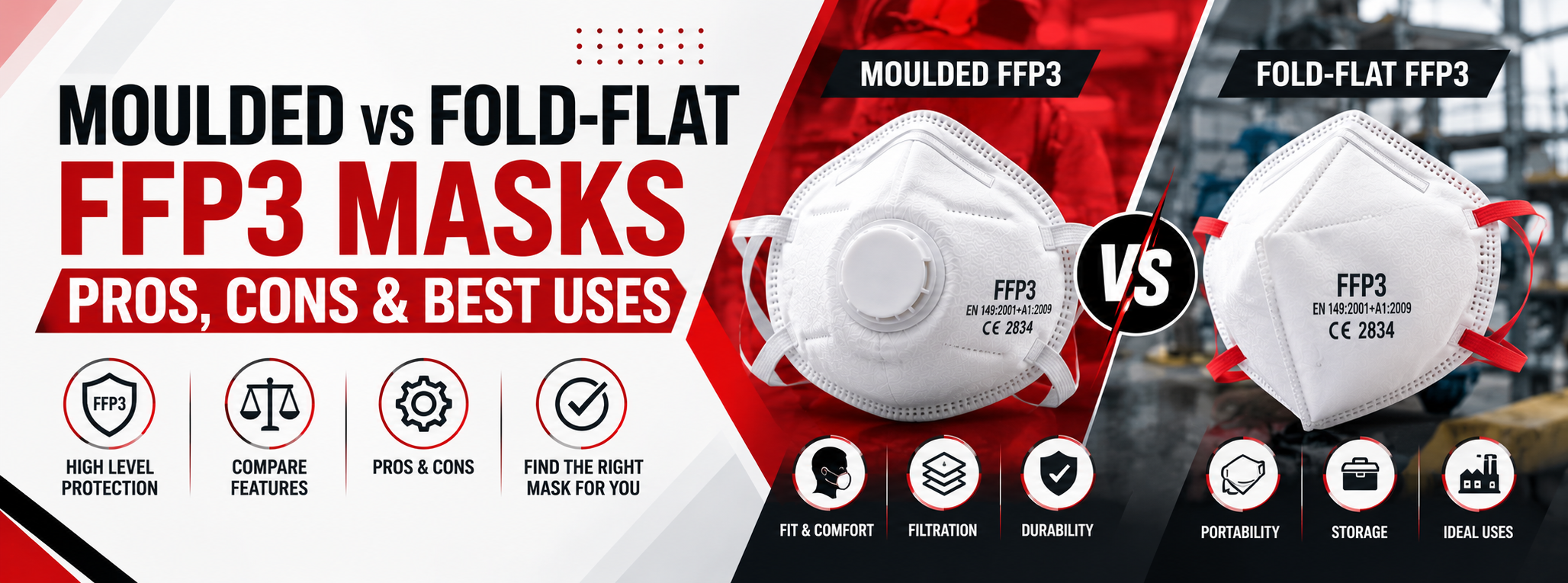
- Fold-flat: stores flat in a van or toolbox. It is also easy to distribute
- Moulded: keeps its shape. So, it fits users who need space to breathe
- Valved: allows warm air to escape. So it is useful for hot, dusty conditions
- Non-valved: filters exhaled air. Hence, it is best to protect others and clean areas from contamination
NHS England cautions that valves do not filter exhaled air. It is fine for most site work. However, for work around others or in clean areas, non-valved is best.
How Many FFP3 Masks Do You Need?
Plan for one mask per person per shift. HSE says to discard disposable RPE after one use, or sooner if you find it difficult to breathe. Here’s a quick overview:
| Team size | Masks per week | Masks per 4 weeks |
|---|---|---|
| 5 | 25 | 100 |
| 10 | 50 | 200 |
| 20 | 100 | 400 |
| 50 | 250 | 1,000 |
| 100 | 500 | 2,000 |
Add about 10% for damaged, wet, or lost masks. Then round up to full boxes.
Cost: Price per Mask vs Total Cost
Listed prices at Respirator Shop run from £1.89 to £8.73 per mask. Here’s what that means for a team of 20 over four weeks, or 400 masks:
| Mask tier | Price per mask | Cost for 400 masks |
|---|---|---|
| FFP3 Eagle Masks (pack of 10, £18.90) | £1.89 | £756.00 |
| Ultimate Valved Fold Flat (pack of 10, £49.00) | £4.90 | £1,960.00 |
| 3M Aura 9332+ (box of 10, £87.33) | £8.73 | £3,493.20 |
In addition to the cost, keep in mind the following things as well:
- Failed fittings: If 20% fail, you need another model on hand
- Testing: Each new model will require more test time
- Waste: Low-cost masks that shred and clog up get thrown away
- Shipping and storage: order in accordance with shelf capacity and shipping minimums
Check out our bulk deals for case pricing. The pack pricing above is for the single pack.
Storage, Shelf Life and Stock Control
Disposable masks have expiry dates. 3M assigns its VFlex line a five-year shelf life from production. Also, the JSP M632 mask expires in five years. Other brands only last three years. Expiry dates can be found on the product.
Here’s how to easily maintain the stock:
- Keep masks in original packaging, clean, dry, and out of sunlight
- Stay within the temperature and humidity range on the box
- Use oldest stock first, and log batch numbers on delivery
- Check use-by dates monthly, and bin anything out of date
What to Do If You Find a Faulty Batch
A poor or faulty batch of masks puts everyone who wears it at risk. Here’s what to do when you find one:
- Stop using the masks, withdraw the batch from the site, and isolate it.
- Document everything. Record the batch number, date, manufacturer, and fault. Take pictures.
- Contact your suppliers and manufacturer. Maintain samples for laboratory analysis.
- Inspect other stocks and see if you have the same batch in your vans, warehouses, and sites,
- Substitute. Reassess compatibility when changing to another model.
- Notify authorities. Use the HSE’s defective product report page to identify authorities to inform.
When FFP3 Masks Are Not Enough
FFP3 handles particles only. A protective mask rated FFP3 won’t stop gases, vapours, or oxygen shortage. Step up when you face these:
- Gases and vapours: Use a reusable mask with gas filters
- Isocyanate paint: HSE says filtering respirators are unsuitable, so use air-fed apparatus
- Other spraying: A spray mask needs filters matched to the coating’s data sheet
- Long shifts: HSG53 advises against wearing a tight-fitting disposable continuously for over an hour
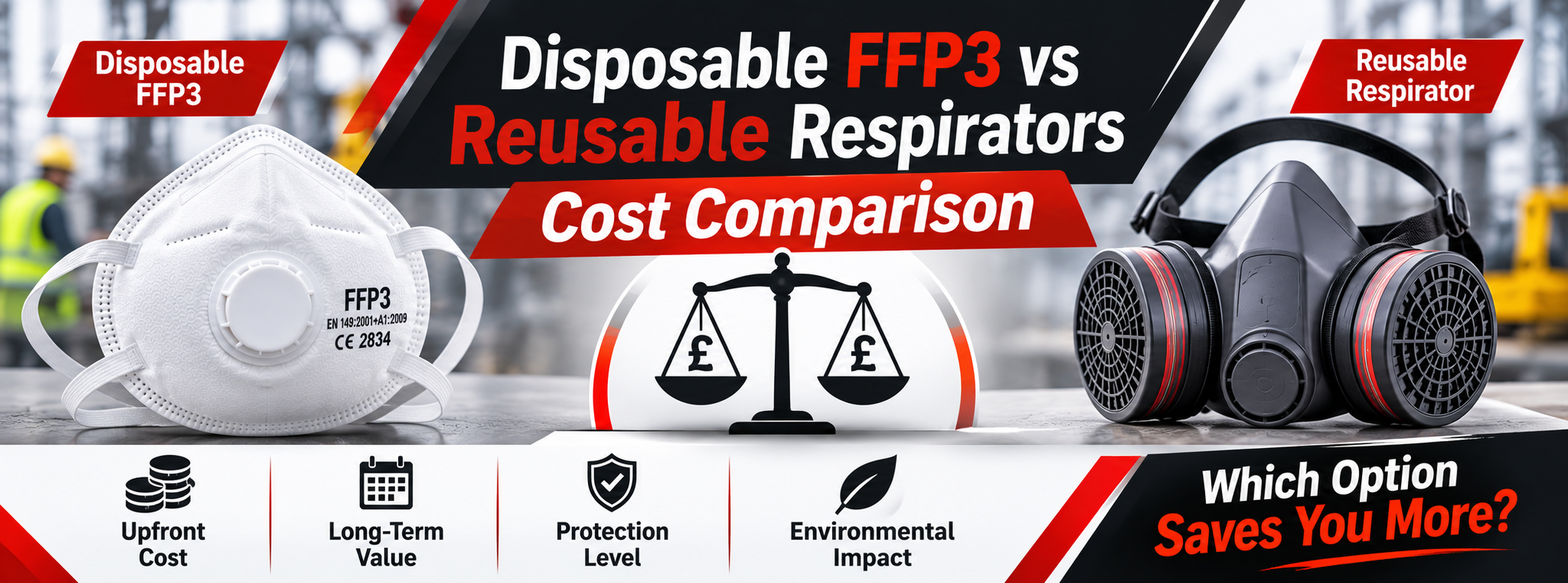
- Daily heavy dust: A reusable half-face mask often costs less
Records, RAMS and COSHH for Contractors
Your COSHH assessment drives RPE choice. HSE’s RPE guide says the hazard data from that assessment selects the right mask. Risk assessments are law. RAMS documents aren’t, but principal contractors often ask for them. Keep these records together:
- COSHH assessment naming the RPE class and the reason
- RAMS listing the mask model, APF, and fit test status
- Fit test reports for every wearer
- Purchase records, batch numbers, and certificates
- Training and toolbox talk sign-in sheets
HSE advises keeping RPE test and examination records for at least five years.
Bulk Order Checklist
Tick every box before you press buy:
- FFP3 is the suitable class for this risk
- Masks come with CE/UKCA mark, notified body number, and EN 149
- Supplier has certificates and declaration of conformity
- Each user has undergone a successful fit test on this particular type
- Small size is available on the list
- Quantity is provided for four weeks along with a 10 per cent buffer
- Shelf life exceeds project period, and storage capacity is available
- Valved or non-valved mask is selected as per the work
- Batch numbering of masks will be done upon arrival
- COSHH and RAMS mention this mask, and records are kept in one place
The Final Thoughts
The secret to making a bulk order is in the proof, not in the cost. Look at the label, try the size, and make your order according to the number of shifts. Add storage, documentation, and poor lot planning to the equation. And you'll have no trouble placing your order.
Need bulk ordering now? Take a look at our selection of FFP3 dust masks and respirators available from the Respirator Shop. Browse our bulk order discounts, and if you need help picking one, give us a call at 01435 510749.
Pair your order with a fit testing kit and get your team protected.
Frequently Asked Questions
1.Do employers have to provide FFP3 masks?
Yes, when your risk assessment recommends it. HSE states that employers have to make RPE available without cost. Fit testing is covered by employers too.
2.Do FFP3 masks expire?
Yes. There is an expiry date on most disposable FFP3 masks. The usual duration is five years; even three years isn't that uncommon. Always refer to the box for information about how to store them.
3.Are bulk FFP3 masks cheaper?
Usually, per mask. Larger quantities reduce the cost per piece. However, ordering in large quantities the wrong model is not a good bargain. First, try fitting.
4.Valved or non-valved FFP3 masks for site teams?
Valved masks are ideal for hot, dusty environments. Non-valved are good for work around people or in clean environments. Many teams stock both.
5.When should a team switch to half-face masks?
Switch when staff wear masks daily, struggle to pass fit tests, or need gas filters. A reusable half-mask is more expensive initially but cheaper during a busy year.