
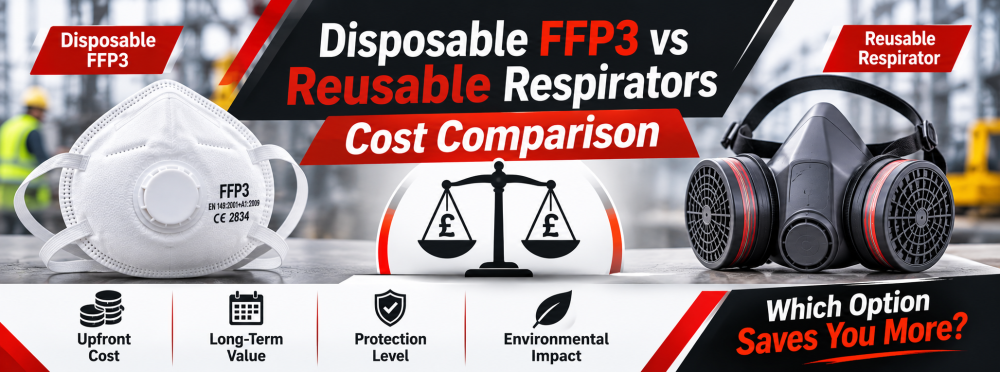
Is a reusable respirator really cheaper than a stack of disposable FFP3 masks? Yes, once you wear one often enough.
Disposable Respirators are cheap upfront and need no upkeep. A reusable half mask costs more on day one but less over time. HSE lists both at an assigned protection factor of 20. That means you can choose on cost and convenience, not safety. Both routes work well when you match them to your workload.
This guide compares listed prices to help you pick the option that fits your shifts.
Disposable FFP3 vs Reusable Respirators: Which Costs Less?
Short answer: it depends on how often you wear a mask. Disposables cost less for occasional jobs. A reusable half mask costs less for regular work. A UK supplier’s guide says daily site workers recover the investment well before twelve months. The sections below show listed prices and one sourced worked example.
Here are two quick definitions:
- Disposable FFP3 mask: a filtering facepiece you wear for one shift, then bin
- Reusable half mask: a rubber facepiece with P3 filters you replace when needed
Both count as tight fitting RPE. Whichever face mask you pick, protection depends on fit. Price should only decide the cost side of the choice.
What Does a Disposable FFP3 Mask Really Cost?
Prices vary with design, valve, and brand. Here are listed Respirator Shop prices at the time of writing:
| Disposable FFP3 mask | Pack size | Listed price |
|---|---|---|
| FFP3 Eagle Masks | Pack of 10 | £18.90 |
| Ultimate Valved Fold Flat FFP3 | Pack of 10 | £49.00 |
| HY9632 Moulded FFP3 | Pack of 10 | £58.00 |
| 3M Aura 9330+ (non valved) | Pack of 5 | £38.00 |
| 3M Aura 9332+ (valved) | Box of 10 | £87.33 |
Other suppliers show a similar spread. One UK guide puts disposables at £1.18 to £1.90 each, and around £1.50 in bulk. Pack size, brand, and valve design explain the gap.
HSE guidance tells employers to throw away disposable RPE after one use. It also says to discard it sooner if it clogs. So you buy at least one mask per shift. Many FFP3 disposable dust masks also get binned early when wet or damaged. Budget for that waste.
A valved ffp3 face mask can breathe easier on long shifts. Remember that the valve lets exhaled air out unfiltered.
What Does a Reusable Half Face Mask Really Cost?
A half face mask covers your nose, mouth, and chin. You buy the mask once and replace the filters. A Reusable Respirator also lets you swap in filters for other hazards. Here is what Respirator Shop lists:
| Reusable item | Listed price | Notes |
|---|---|---|
| JSP Force 8 with P3 Press To Check filter | £23.03 | Includes P3 filter |
| FFP3 Half Mask (P3 filters included) | £28.00 | Includes P3 filters |
| Sundstrom SR100 and P3 filter | £40.00 | Silicone half mask |
| JSP Press To Check P3 dust filters | £9.75 | Replacement set of 2 |
Source: the linked Respirator Shop product pages.
Filters are your running cost. A UK supplier’s guide lists SR510 P3 filters at £8 to £12 each. It says moderately dusty work might need new filters every one to three months. Your real filter life depends on dust load and maker advice.
How to Calculate Your Own Cost
Use these five steps to compare both options. They follow a published UK guide. It multiplies masks per day by days per week by weeks worked.
- Count your shifts. Estimate how many shifts you wear a mask each year.
- Price one disposable. Divide the pack price by the pack size.
- Price the reusable setup. Add the mask body to the first filter set.
- Add filter changes. Divide your shifts by shifts per filter set. Multiply by the set price.
- Add the extras. Include cleaning supplies, spare parts, fit testing, and your own time.
Worked Examples: Light, Regular and Daily Use
Respirator Shop doesn’t publish usage scenarios. So every example below comes from a UK supplier’s cost guide. We have not added figures of our own.
- Light use, once or twice a month: the guide says a small pack of disposables is the best option. The upfront saving outweighs filters you would never fully use.
- Regular use, most working days: the guide says you can typically save money within the first year by switching to a reusable mask.
For daily use, the guide gives a full worked example. Here are its figures:
| Daily use, one worker | Disposable FFP3 | Reusable half mask |
|---|---|---|
| Usage assumed | 1 mask a day, 5 days a week, 48 weeks | Sundstrom SR100 with 6 filter changes a year |
| Unit prices | £1.50 per mask | £40 for the mask, £10 per filter |
| Yearly total | 240 masks, £360 | £40 plus £60 of filters, £100 |
| Saving per year | None | About £260 for one user |
Costs People Forget
The sticker price tells only part of the story. Add these items before you decide:
- Fit testing: Both types need it. HSE says the employer pays.
- Retests: HSE asks for a repeat test when the model or size changes. Switching disposables often adds retests.
- Cleaning, storage, and spares: Wipes, a clean case, and new valves, harnesses, or seals
- Your time: Cleaning and checking take minutes on every shift
- Waste charges: The UK guide notes that large volumes of disposables can raise disposal costs
Do Disposable and Reusable Respirators Give the Same Protection?
On paper, yes. HSE rates filtering half masks and P3 half masks at APF 20. Real protection depends on fit, though. An NHS review found 20% of tested staff failed in the first Covid wave. A pre-use seal check never replaces a fit test, HSE warns. Both Disposable Respirators and half masks need testing.
Dust is not a small risk. HSE reports around 4,000 work related COPD deaths each year. A few differences do matter:
- Filter choice: only reusable masks take gas and vapour filters
- Valves: a valve can improve comfort, but exhaled air leaves unfiltered
Maintenance and Record-keeping Cost of Reusable Masks
Reusable masks carry an admin load that disposables avoid. HSE guidance says reusable RPE needs thorough examination and testing at least monthly. If you use it only occasionally, test it before use. The gap must never exceed three months. HSE also says to replace worn valves and face seals during maintenance.
Keep records too. HSE advises retaining RPE examination and test records for at least five years. A simple log covers it:
- Mask identifier, wearer, and date of each check
- Condition of valves, harness, and face seal
- Filter changes, with dates and reasons
Which Option Suits Your Job?
DIY and occasional users
You need protection a few times a year. Disposables win here. The UK guide agrees. It rates small disposable packs best for jobs once or twice a month. Choose ffp3 dust masks from our FFP3 range. Fit testing rules apply at work. At home, still check the seal every time.
Tradespeople and daily site workers
You wear a mask most shifts, so reusable wins. The same guide says the investment is recovered before the twelve month mark. A half face mask with replaceable filters also feels steadier through a long day.
Teams and multi-site contractors
Standardise where you can. Each model needs its own fit test, so fewer models mean fewer retests. Issue reusable masks to your core crew. Check our bulk deals for volume pricing. Remember that employers must supply PPE free, so budget for the whole team.
Contaminated or hazardous work
For non-licensed asbestos tasks, HSE accepts disposable FFP3 masks and P3 half masks. Its guidance says to bin disposables as asbestos waste after one use. Decontaminate reusable masks and bin used filters as asbestos waste too. Gas or vapour hazards need combination filters, so only reusable masks fit. Licensed work follows stricter rules, so check HSE first.
Conclusion
Disposables suit light use. Reusable masks suit regular and daily use. Count your shifts, add the hidden costs, and compare per shift. Then fit the test whichever you pick.
Ready to compare for yourself? Browse the full FFP3 range at Respirator Shop, from budget packs to premium masks. Prefer reusable? See our reusable respirators and matching P3 filters. Need face fit testing? Check our fit testing kits. Questions? Call 01435 510749.
Frequently Asked Questions
Is a reusable respirator cheaper than disposable FFP3 masks?
Usually, yes, for regular use. The UK guide’s worked example shows about £260 saved per user in a year. For occasional jobs, disposables stay cheaper.
How often should you change P3 filters?
There is no fixed shift count. HSE says to follow the maker’s advice. Change filters if the shelf life has passed. Change them if they are damaged or visibly contaminated. Change them if breathing gets harder.
Can you reuse a disposable FFP3 mask?
Generally, no. HSE says to discard disposable RPE after one use. Some newer models are marked R for reusable. Healthy Working Lives notes that only those may be reused, following the maker’s instructions.
Do you need face fit testing for both types?
Yes. Both are tight fitting, so both need a fit test. HSE guidance asks for a retest when the RPE model or size changes. A press to check the filter does not replace the test.
How do you clean and store a reusable half face mask?
Follow the maker’s instructions. A typical routine looks like this:
- Remove the filters and bin them if blocked
- Take off the valve cover, harness, and diaphragm
- Wash the parts in warm soapy water, as in 3M’s cleaning guide, then air dry
- Store the mask in a clean, dry place away from dust