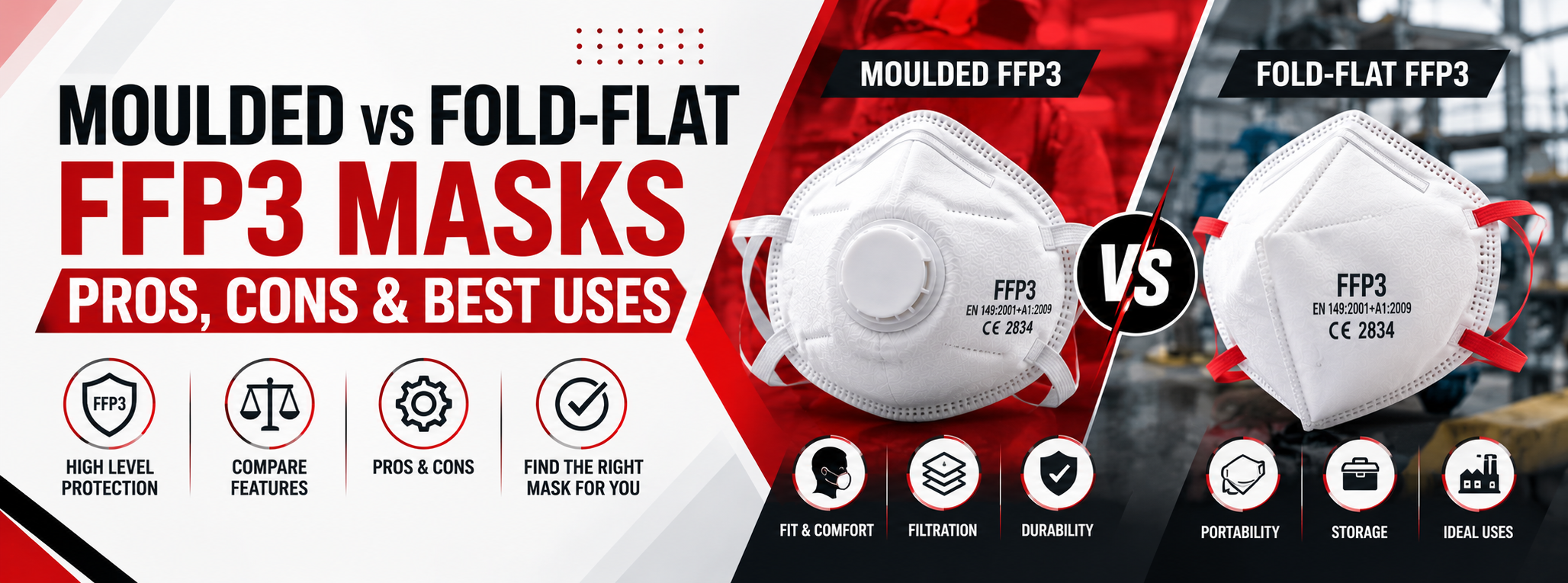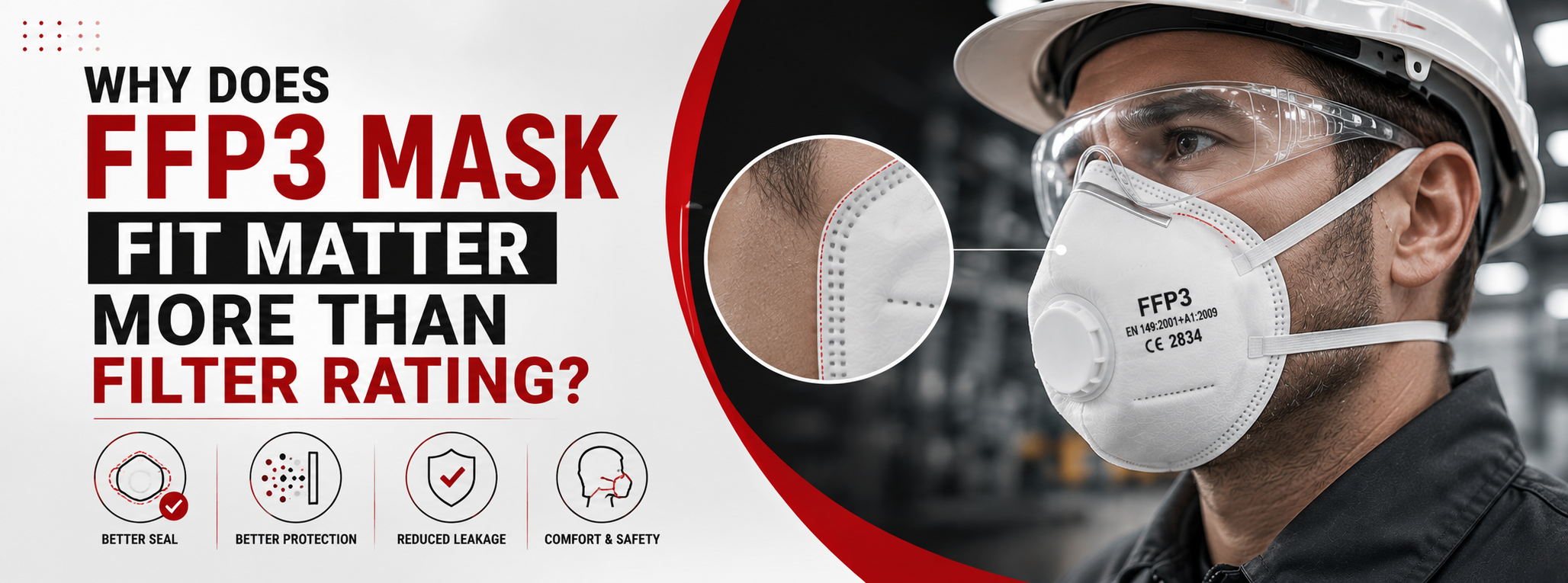
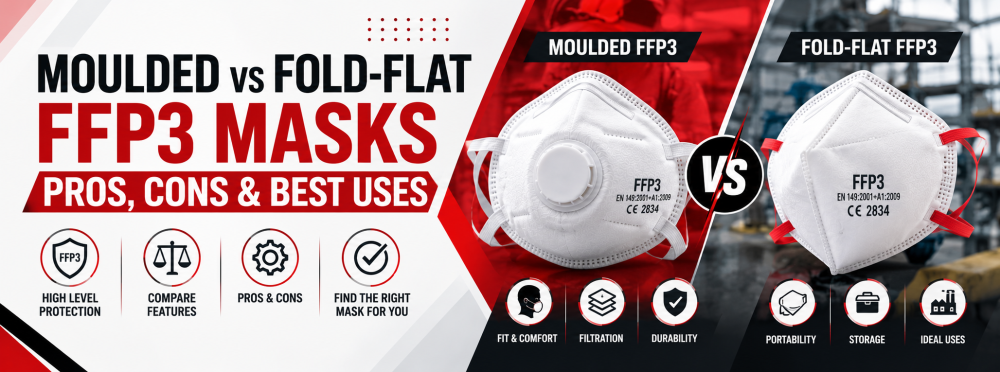
Moulded and fold-flat FFP3 masks offer the same high level of filtration, but they feel and fit very differently. One holds its shape and often feels more structured; the other folds flat for easy storage and can sit closer to the face.
The better option depends on the seal, which matters in real-world protection. HSE assigns FFP3 an assigned protection factor of 20. It means a properly fitted mask should reduce inhaled dust to around one-twentieth of the surrounding level.
The goal is simple: Choose a mask that remains comfortable during an entire shift and continues working effectively.
So how do you find out which design fits your facial features and occupation? Let’s find out!
Moulded vs Fold-Flat FFP3 Masks: What Is the Difference?
EN 149 specifies one FFP3 standard, and all have to comply with this standard. What really matters is shape.
Moulded FFP3 Masks feature a pre-formed cup. They retain their shape after leaving the pack. This leaves room in front of your mouth. On the other hand, fold-flat FFP3 masks come as a flat panel. You open them out and press the nose clip into place.
Both must meet the same class limits. EN 149 requires FFP3 to filter at least 99% of particles. Here’s how the styles differ in daily use.
| Feature | Moulded | Fold-flat |
|---|---|---|
| Shape | Rigid, pre-formed cup | Flat panel that opens out |
| Storage | Bulky; can crush in a bag | Slips into a pocket |
| Space at the mouth | More room | Less room, depends on design |
| Packaging | Often boxed in bulk | Often individually wrapped |
| Filter grade | FFP3 (same) | FFP3 (same) |
| Fit | Varies by model and face | Varies by model and face |
Moulded FFP3 Masks: Pros, Cons and Best Uses
Moulded masks suit people who want a structured, roomy shape. Here’s a quick overview of benefits and limitations:
Pros
Moulded designs earn their place for three reasons:
- The cup keeps its shape, so it does not collapse when you breathe hard.
- Extra space around your mouth makes talking easier.
- A pre-formed shape goes on fast, with no unfolding.
Cons
The same rigid shape leads to certain drawbacks:
- It requires more space to be stored in the pocket or toolbox.
- It could get bent out of shape while packing without any container.
- It would not be suitable for all kinds of faces.
Best Uses
Choose moulded when you wear the mask for hours and need to store it safely. Typical jobs include:
- Long shifts in dusty workshops.
- Sanding, sawing, and demolition.
- Roles where you talk often.
Moulded FFP3 Product Examples
Respirator Shop stocks these moulded options:
- HY9632 Moulded FFP3 (Pack 10): a multi-pack for regular users.
- Moulded FFP3 Masks P303: another moulded option to test on your face.
Fold-Flat FFP3 Masks: Pros, Cons and Best Uses
Fold-flat masks suit people who carry spares and prefer easy storage. Here is how they compare.
Pros
Fold-flat designs offer benefits in convenience:
- They lie flat, so a spare fits in a pocket.
- Many come individually wrapped, so each stays clean until you use it.
- Three-panel types flex with facial movement, as 3M describes its Aura range.
Cons
Convenience does not guarantee a seal, which causes certain disadvantages:
- Less structure can mean less room at the mouth.
- Fold-flat designs fit very differently. Three-panel and vertical types can perform far apart.
Best Uses
Choose fold-flat when you move between tasks and want a clean spare on hand. Typical jobs include:
- Site visits and short, occasional tasks.
- Tradespeople who keep a spare in a pocket.
- Teams that want each mask wrapped for hygiene.
Fold-Flat FFP3 Product Examples
Respirator Shop stocks these fold-flat options:
- Fold Flat FFP3 Individually Wrapped: a single-wrapped mask for spares.
- Ultimate Valved Fold Flat FFP3 Masks (Pack of 10): a valved multi-pack for longer shifts.
- 3M Aura 9330+ (Pack of 5): a branded flat-fold, three-panel option.
Which Is Better: Moulded or Fold-Flat FFP3?
Both styles are not suitable for all individuals, as the research suggests.
A review of eight studies was conducted to compare respirator styles. Cup-shaped masks were more successful in four studies than any other style. Yet, another study reported that a three-fold mask design did better than cup-shaped masks.
Those studies tested N95 masks, but the fit principle carries over.
Here’s how you can narrow your choice:
- Choose moulded if you wear it for hours, talk often, and can store it flat.
- Choose fold-flat if you carry spares, want wrapped masks, or a cup will not seal.
Shape only gets you to a shortlist. Buy small packs of two or three models, then keep the one that seals best. A fit test shows which mask seals on your face. Trained testers can buy face fit testing kits from Respirator Shop.
Valved or Non-Valved FFP3 Masks?
A valve changes comfort, not the filter grade.
A valve lets warm breath escape, which cuts heat on long jobs. It does not filter your exhaled air, even with a shrouded valve. A non-valved mask filters both ways.
Pick by task:
- Valved suits hot, dusty, solo work, such as the Ultimate Valved Fold Flat FFP3 Masks.
- Non-valved suits shared spaces and clean areas, such as the FFP3 Non-Valved Masks (HY9330).
NHS England warns that valved respirators should not be worn during sterile procedures. Keep that in mind for any clean-room or healthcare task.
Do You Need an FFP3, FFP2 or FFP1 Mask?
The right grade depends on the dust. Here’s how they differ:
| Mask grade | Minimum filtration | HSE protection factor | Typical job |
|---|---|---|---|
| FFP1 | 80% | 4 | Low-risk nuisance dust |
| FFP2 | 94% | 10 | Lower-risk dust |
| FFP3 | 99% | 20 | Construction dust, higher-risk work |
Maximum levels of filtration can be defined in accordance with the EN 149 standard. The protection factors have to be determined according to HSE recommendations.
The general level of protection against exposure to construction dust has to provide the protection factor of 20 based on HSE. Practically, it implies FFP3 or a half-face mask with P3 filters. FFP2 can be considered adequate protection against low-risk dust, i.e. where a protection factor of 10 is sufficient. FFP1 is used for low-risk nuisance dust.
Many shoppers call any disposable respirator a dust mask. The grade on the pack matters more than the name. When in doubt, choose the FFP3 face mask.
When to Choose a Half Face Mask Instead
A reusable mask can beat a disposable one for heavy or daily use.
A half-face mask has a rubber or silicone body with replaceable P3 filters. For construction dust, HSE lists a half mask with P3 filters alongside FFP3.
Consider one when:
- You wear a respirator everyday at your place of work, and therefore, the cost of filter replacement is more economical.
- You need filters for gases or vapors as well as for dust.
- You do dusty work, and disposable masks will be clogged easily.
- You want a reusable facepiece that can be tested and cleaned.
Reusable half masks also require fit testing, and the filters should be compatible with your hazard.
How to Check Your FFP3 Mask Fits
The fit check should not take longer than a minute. Follow the steps:
- Verify that all areas of your skin that come into contact with the seal of the mask have been shaven.
- Hold the mask cupped beneath your chin with the nose piece facing upwards.
- Pull up the upper strap to the top of your head and position the lower strap around your neck.
- Apply the nose clip firmly against the nose bridge with both hands.
- Gently exhale and feel for any air leaks.
- Inhale quickly; the mask should tighten slightly against your face.
In the case of fold-flat masks, make sure that all panels are opened first. Moulded masks should be kept free of your mouth.
Perform these steps until you can confirm there are no leaks. This will tell you that your mask fits. It cannot confirm that it fits your face though.
Conclusion
Moulded and fold-flat FFP3 masks give the same filter grade. Moulded masks add structure and mouth space. Fold-flat masks add storage ease and wrapped hygiene. Neither shape guarantees a seal. Test for fit, check the seal each time, and match the grade to your dust. Do you mask up daily, or face more than dust? Look at a reusable half-face mask.
Need help narrowing it down? Start with the range below. Find your fit and shop moulded and fold-flat FFP3 masks Respirator Shop!
Frequently Asked Questions
Are moulded or fold-flat FFP3 masks better for small faces?
Neither shape wins for every small face. Studies disagree, which suggests the model matters more than the shape. Look for a small size, then test the seal. One example is the Small FFP3 Masks Alpha S-3V (Pack of 5).
Can you wear an FFP3 mask with a beard?
Not safely. Hair under the seal lets air leak. HSE advises against fit testing through facial hair. If you cannot shave, choose a loose-fit powered air-purifying respirator.
Can you reuse an FFP3 mask?
Check the marking. NR means one shift only. R means the mask may be reused beyond one shift. Bin any mask that is damp, dirty, or damaged.
Is P3 the same as FFP3?
Nearly. P3 is the filter grade. FFP3 names a whole disposable mask made to that grade.
Which mask is best for sanding and plastering?
FFP3 is the safe default. HSE sets a protection factor of 20 for construction dust. For plasterboard joints, HSE says good dust extraction can remove the need for RPE. Both moulded and fold-flat suits are available, so pick the one that passes your fit test.