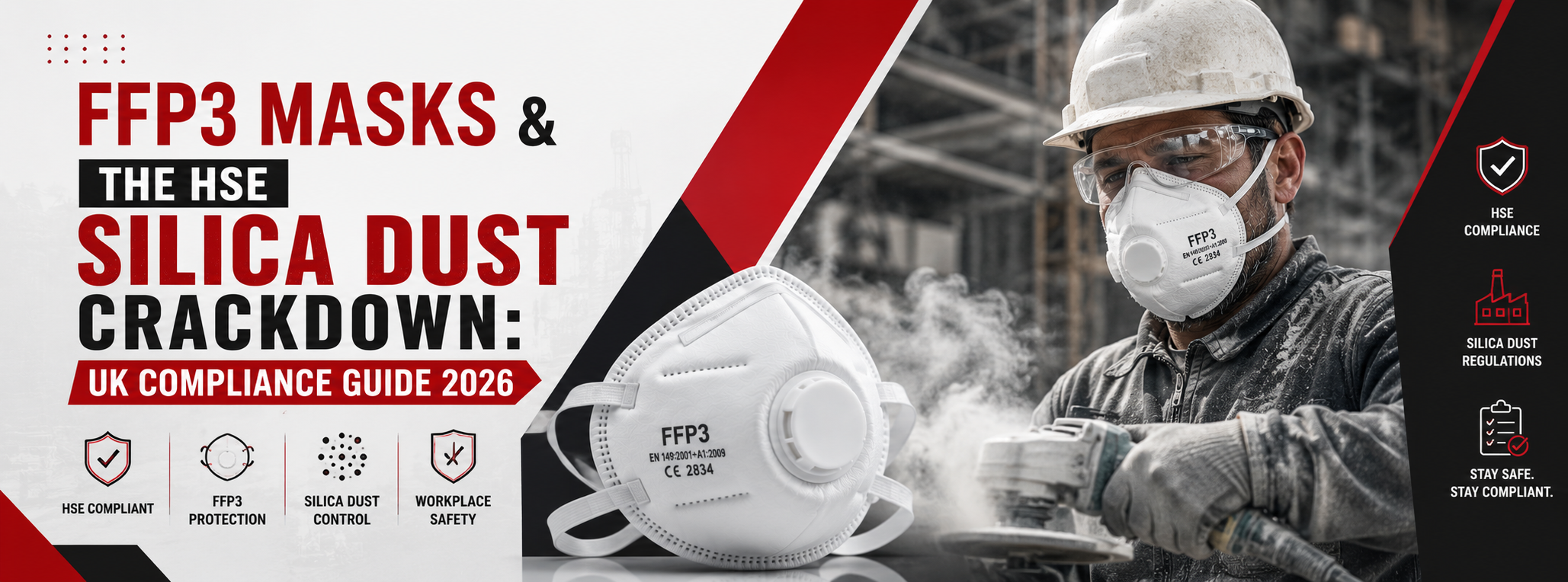
Selecting protective masks helps in safeguarding the health of workers. In any workplace with airborne hazards, wearing the wrong mask can be harmful to workers’ health. The selection of masks from FFP1, FFP2, and FFP3 is directly dependent on need of the work environment.
Each respiratory mask provides a specific amount of protection. The knowledge of these protection levels enables you to select dust masks based on the risk level at workplace. In this blog, we will understand about ffp3 face mask and the selection guide.
Difference between FFP1, FFP2, and FFP3 Face Masks
| Feature | FFP1 | FFP2 | FFP3 |
|---|---|---|---|
| Filtration Efficiency | At least 80% of airborne particles | At least 94% of airborne particles | At least 99% of airborne particles |
| Protection Level | Basic protection | Medium to high protection | Highest level of disposable protection |
| Suitable For | Low-level dust and non-toxic particles | Moderate dust, fumes, and aerosols | Fine toxic dust, fumes, and hazardous particles |
| Common Work Environments | DIY work, light sanding, low-risk tasks | Construction, agriculture, general industry | Healthcare, silica dust, asbestos, heavy industrial use |
| UK Compliance Requirement | May not require fit testing in low-risk settings | Fit testing required if tight-fitting RPE is mandated | Mandatory face-fit testing in regulated environments |
| Typical Use Case | Minimal risk exposure | Moderate occupational exposure | High-risk occupational exposure under COSHH |
Why FFP3 Masks Are Considered the Highest Level of Disposable Respiratory Protection
FFP3 masks are one of the best respirator that follows European standards. FFP3 face masks are made to filter 99% of airborne particles. This includes small dust, bad fumes, and aerosols. This makes FFP3 face masks a good choice when you are exposed to harmful dust.
Types of FFP3 Masks People Commonly Choose
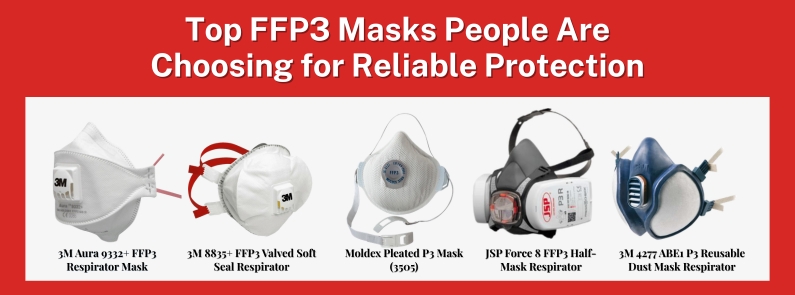
- 3M Aura 9332+ FFP3 Respirator Mask - This is the most used respirator mask in the construction and healthcare industry due to its valved structure. This limits the amount of heat and provides up to 99% filtration protection suitable for long shifts.
- 3M 8835+ FFP3 Valved Soft Seal Respirator - It can be used at high-risk industrial and demolition applications and has a soft seal that enhances comfort and minimizes the inward leakage during prolonged tasks.
- Moldex Pleated P3 Mask (3505) - This mask has a low breathing resistance, is adjustable, and ideal to use for many long hours in a dusty environment where protection and comfort are of great importance.
- JSP Force 8 FFP3 Half-Mask Respirator - This is a reusable half face mask featuring replaceable P3 filters and an adjustable fit. This respirator fits well for woodworking or other trades with frequent applications.
- 3M 4277 ABE1 P3 reusable dust mask respirator - A rugged reusable respirator with a fast-fitting design with a silicon seal that is good for use in a heavy industry that needs reliable filtration over long shifts.
What are the Key Features to Check in FFP3 Mask
- Check if the selected face mask is labelled as FFP3 or not. If the selected respiratory mask is labelled as FFP3, then you can use it in your hazardous workplace. It is because FFP3 masks provide up to 99% filtration of fine airborne particles.
- Select the design that forms a secure seal on your face. It is significant since the filter cannot work correctly if the air leaks on the sides.
- You can select a mask with an adjustable nose clip when you have glasses or have a distinctive nose shape.
- You can choose the masks with strong head straps instead of ear loops. Because head straps are more comfortable and fit better.
- Select the valved and the non-valved masks according to the working conditions. Valves enhance the ability to inhale and exhale, and non-valved masks provide better security in a clinical workplace.
- A soft layer inside the mask can help avoid irritation and pressure marks in case you are wearing the masks during hours.
- You can choose FFP3 dust masks that have low breathing resistance. This makes you feel more comfortable during long shifts and can reduce fatigue.
- Individually wrapped masks add extra layers of hygiene at workplaces with more fine particles.
- It is important to ensure the mask has passed face-fit testing. This ensures the mask provides reliable protection against harmful dust.
Where FFP3 Masks Are Most Commonly Used
- In construction and demolition sites, where the cutting, drilling, and breaking of materials emits fine dust such as silica into the atmosphere.
- At work during asbestos removal, the UK has rigid laws to ensure high-level respiratory protection against inhalation of harmful fibres.
- In medical institutions and clinical practices, especially the implementation of procedures that can produce airborne particles or infectious individuals.
- Within factories and industrial units, where the workers are subjected to metal fumes, fine powders, or chemical particulates.
- FFP3 face masks can be used at Woodworking and carpentry workshops. These places involve sawdust and fine wood particles that can affect your health.
- FFP3 masks are also suitable for laboratories and pharmaceutical plants. It helps in filtering harmful particles and prevents them from becoming contaminated.
- During waste management and environmental services, employees often work in contact with airborne contaminants or bioaerosols.
- In some farming conditions, there is a risk of respiratory hazards due to grain dust, mould spores, or airborne residues.
Conclusion
Selecting an FFP3 face mask should never be a routine purchase decision. It directly impacts worker safety and legal compliance. The right choice of ideal respirator mask depends on the level of risk, certification, and achieving a secure fit based on face fit testing.
Without these necessary aspects, even a high-rated FFP3 dust mask can’t guarantee the required protection. By understanding protection levels, selecting the suitable designs and certified respiratory masks for your workplace becomes important. You can check trusted suppliers like Respirator Shop to get genuine protective dust masks.
FAQs
What Makes an FFP3 Mask Different from Other Masks?
An FFP3 mask provides the highest level of protection to workers. It also comes with certifications and complies with UK and European standards. It comes with 99% filtration efficiency. This ensures effective protection against fine dust, fumes, and hazardous particles as compared to FFP1 and FFP2 masks. This indicates its suitability in high risk workplace.
Which FFP3 face mask is suitable for long working hours?
Comfort is more important than filtration level during long shifts. Workers choose 3M Aura 9332 + or Moldex pleated P3 masks due to low breathing resistance, tight head straps, and designs that minimize heat build-up. Fit is the final decision because a comfortable mask with a good fit can be worn for long working hours.
Are valved FFP3 masks safer than non-valved masks?
Valved masks have a one-way valve that eases the breathing-out process and minimizes heat accumulation, which makes them more comfortable during long periods. It only protects the wearer since exhaled air is not filtered. Unvented masks air both the inhaled and exhaled air and protect the wearer and anybody nearby.
Which FFP3 masks are used in industries?
Durable masks with strong seals and headband straps work best in industries with excessive dust or fumes. PPE masks such as reusable half-mask respirators, P3 filters, or long-lasting disposable FFP3 masks from trusted suppliers can be used. It is because of their reliable performance and comfort while working.
Which masks are safe in high-risk work areas?
The high-risk workplace that operates for asbestos removal, asbestos-contaminated manufacturing, or other potentially dangerous manufacturing processes. Under UK regulations, a face-fit tested FFP3 mask can be used in high-risk areas. Some difficult work requirements require the use of powered air-purifying respirators (PAPR) due to the workplace risk assessment.